Drag it. Everyone's told.
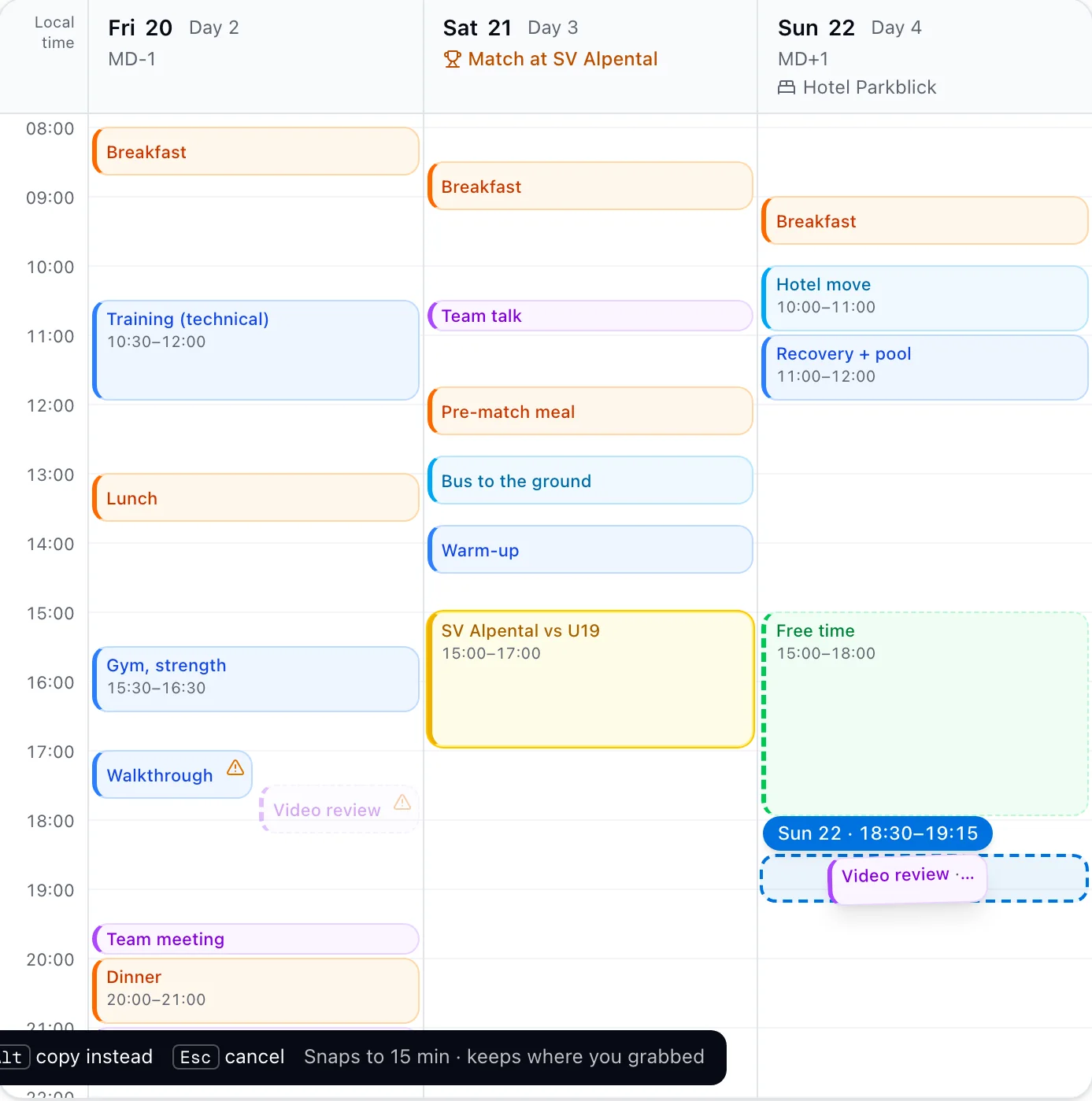
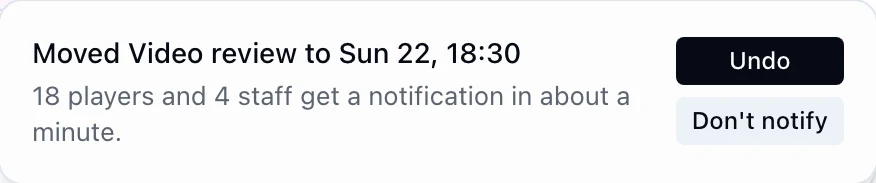
Schedule →Move training on the calendar and the players it affects get one notification a minute later. Change your mind inside that minute and nobody hears a thing.
Matchday runs the season for the people who run the team: the week, the trips, the documents and the money in one place, with a free app in every player's pocket.
No form. The add row at the bottom of every day reads a time, a duration and a title in any of five languages, and shows you what it understood before you press Enter.
2150 bus to hotel 30mTravel, 21:50 to 22:20, everyone9 gym 1h30 staffTraining, 09:00 to 10:30, staff onlyvideoMeeting at the next free hour, the template's room and lengthארוחת ערב 1930Meal, 19:30. Hebrew, German, Spanish and French work the sameThe jobs that eat a manager's Sunday evening: the pitch is late so everything shifts, Tuesday should look like Monday, next month should look like this one. Pick one and watch it happen on a real week.
Every card below runs on a real product rule. Hover one.
Move training on the calendar and the players it affects get one notification a minute later. Change your mind inside that minute and nobody hears a thing.
Today, the bus, the room, the wellness check. One tap to say they can't make it. A lock-screen widget on match day.
Every leg, the wait between them, who lands when. Two groups on two planes, one connection, read as one journey.
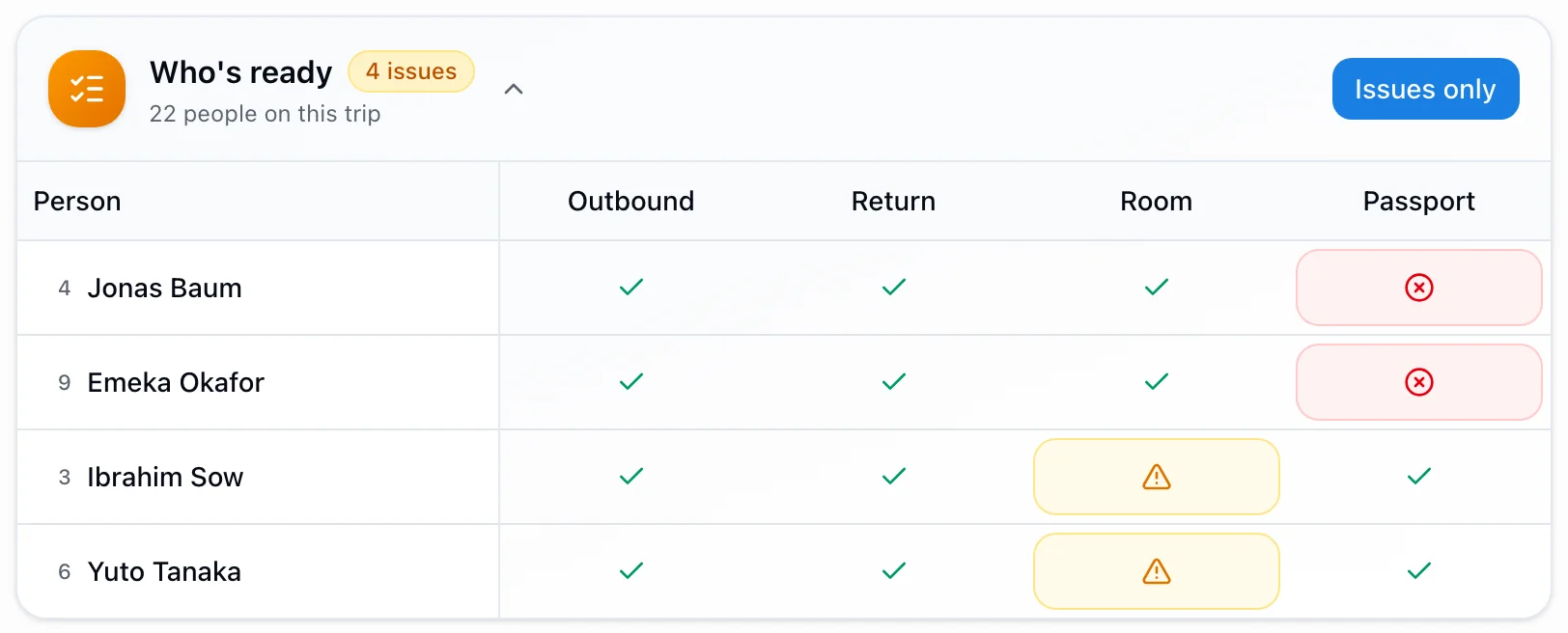
One board, worst first. Visa column appears only when a hotel's country needs one. Every gap links to the screen that fixes it.
A two-minute check sent on its own schedule. Three red answers in a row and the right staff member knows, never the value, never the whole team.
Squad, captain, formation, score and every event from one sheet. Result pushed to the squad when the whistle goes. Any team sport, with football's play-by-play.
Foreign cash counts at the rate you actually got. Card spend at the bank's rate. Receipts come out as one numbered PDF.
Send one link. A player or a parent fills the roster fields, uploads the passport and signs the policies from a phone. Nothing touches the roster until you approve it.
Plain questions over your own data, with the same permissions you have. It proposes a change, you confirm it, then it runs.
The schedule as a live page a parent or a hotel can open with no account, in their language, subscribable from their calendar. Change it after and the link is already right.
Pick a moment. Each one is a real screen.
The gate list is the real manifest: every booking that flies this leg, ticked from any staff phone, settled last tap wins when two of you are offline. The count sits on the lock screen until wheels up. Everyone here, and the staff get one push.
Drop a photo, or point the phone at the page. The two machine-readable lines are read by our own software, the number and expiry confirmed by a second read of the printed page. Only what both reads agree on is filled in. The photo is stored without its metadata. No AI provider ever sees a passport.
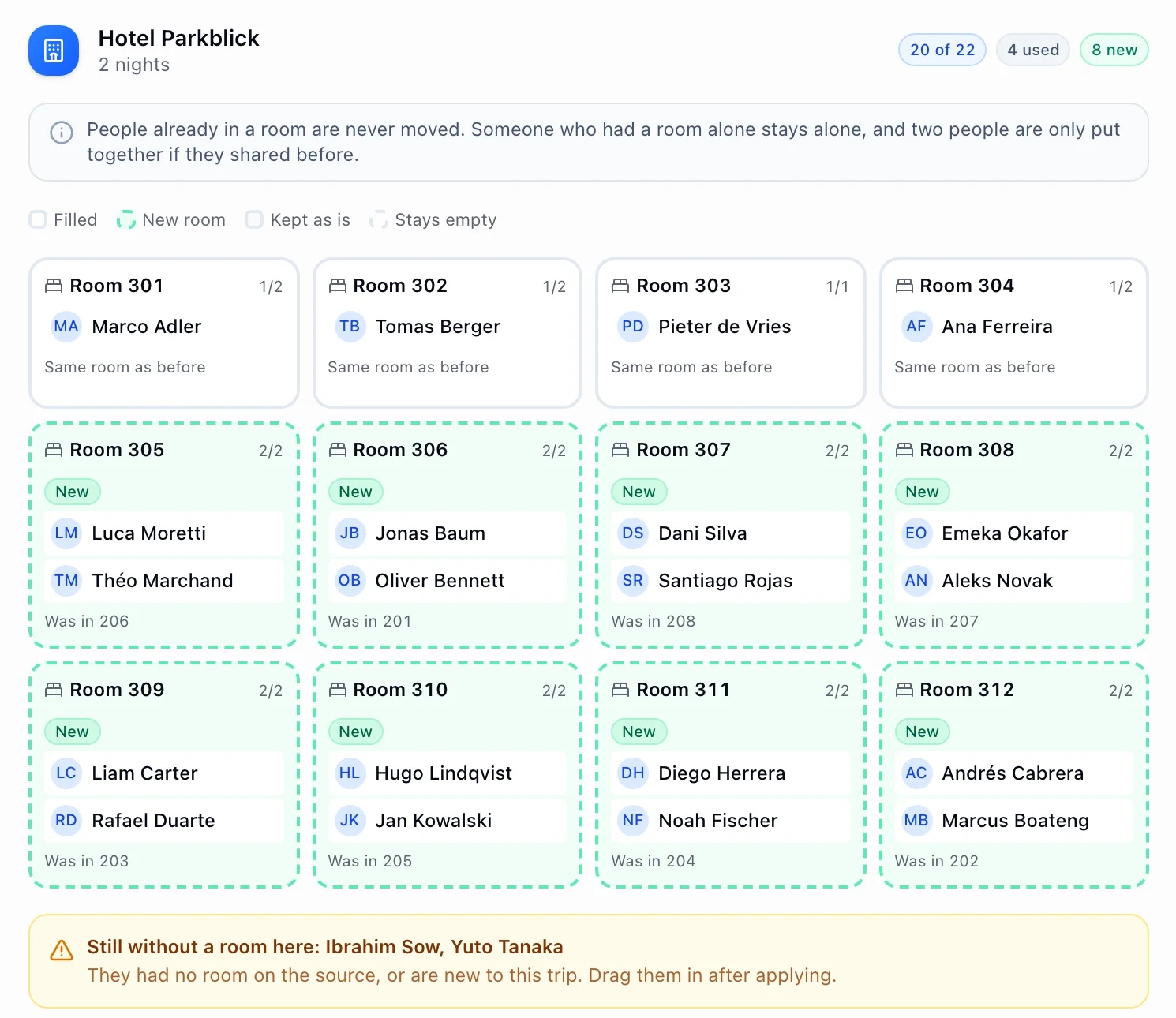
Point the new hotel at a trip you already ran. Pairs stay pairs, anyone whose old room number is free keeps it, rooms that do not exist yet are created and marked New, and nobody is put in with a stranger. Anyone it cannot place is named, and every free bed is one click.
One product, two ways of running a year. A club lives in weeks. A federation lives in windows. Matchday switches at the organisation level.
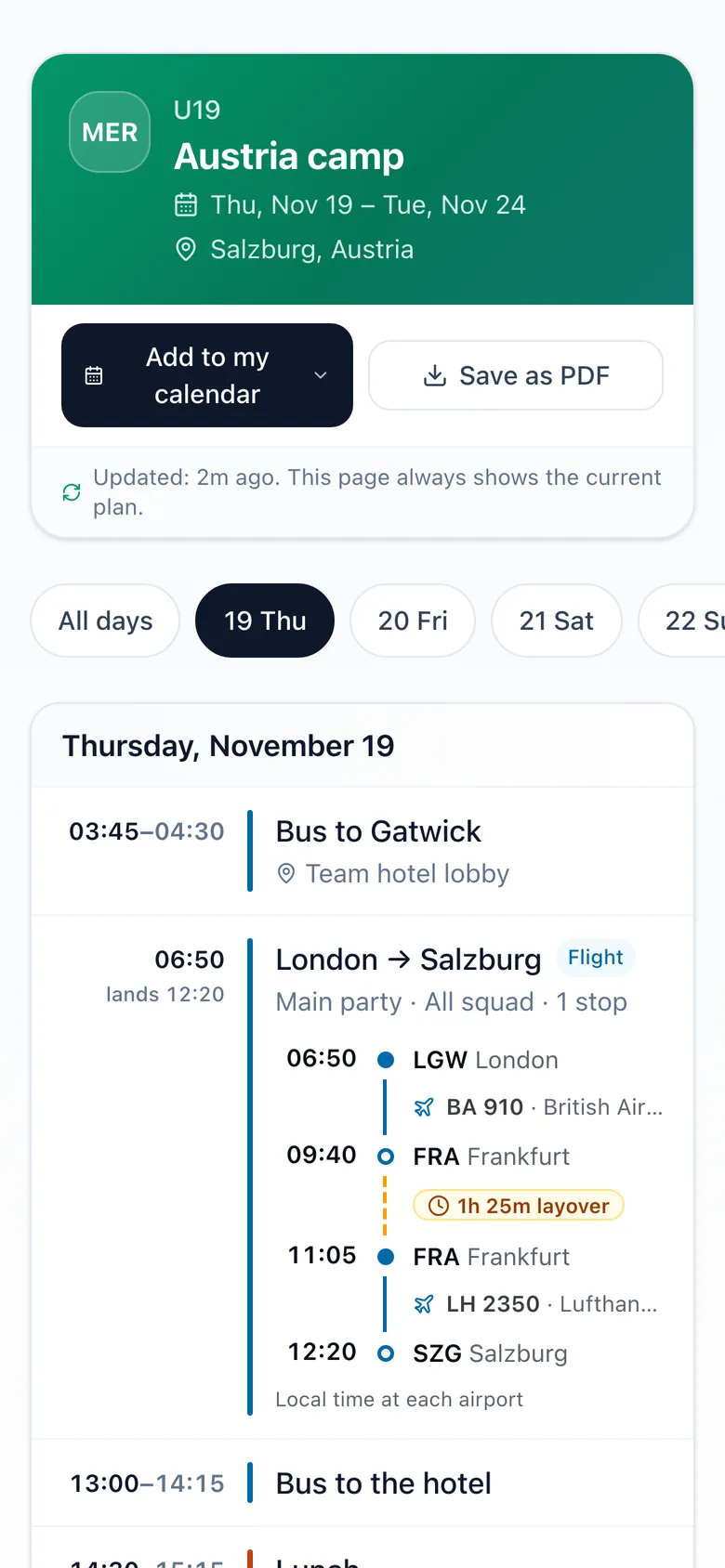
Screens from the live product, shown with demo club data.
You pay for the organisation. Nobody on the squad ever sees a price.
Documents are read by our own software on our own servers. No AI provider ever sees one.
Every change tells exactly who needs to know, once, with a minute to take it back.
Drop your roster workbook. Columns map themselves, in Hebrew too, and it round-trips back out.
An afternoon, not a quarter. Export your roster to CSV and drop it into the import wizard; columns map automatically (Hebrew headers too), and validation catches problems before anything is saved. Your calendar builds from templates, your first trip can be copied from the last one you ran, and players see the week on their phones the same day.
Every staff role gets per-feature view/edit permissions: roster, schedule, logistics, documents, forms and more. Sensitive personal data is masked for view-only users, medical answers are gated behind a dedicated permission, and every change lands in an audit trail.
Barely, and you never need to know their email in advance. You send an invite from the roster and the player claims it with whichever sign-in they already use: Google, Apple, or an email address and password with a one-time code. Nothing to install from an IT department, no shared logins. You keep managing the squad list exactly as you do today.
A real one. Matchday is on the App Store for iPhone, and it is two apps in one binary: players get their schedule, forms, bookings and documents, and staff get the operational half, meaning today’s agenda, attendance, airport roll call, packing ticks, trip expenses from a photographed receipt, and the chase-up lists. Everything else, the authoring and the reporting, lives in the browser on any device. Android is on the way; the web app works there today.
The parts that happen away from a desk are built for it. Roll call and packing ticks record the moment you tapped rather than the moment the server heard about it, so two phones ticking the same list settle themselves rather than overwriting each other, and a tap made in a dead spot is not a tap you have to repeat. Screens you already loaded keep showing what they had instead of going blank.
No. Adding a single item stays quiet. Changing the day, time or place of an existing item tells only the players and staff it touches who have the app, after a one-minute pause, as a single push notification. Move it three times within a minute or so and they get one; undo it in that time and they get none. The toast tells you how many people it will reach before anyone is told, with a Don’t notify button beside Undo.
Matchday runs in two modes. Federations get international windows, cross-team call-ups where documents follow the player, call-up letters each club confirms online, campaign-grain seasons and travel-document readiness per camp. Clubs get the season calendar, weekly templates and rollover. Same platform, your shape of the game.
Yes. Matchday is built for team sports, plural: football, basketball, volleyball and handball come out of the box, each with its own score format, squad sizes and matchday vocabulary. The calendar, travel, wellness forms, documents and the player app work the same in every sport; football adds a full play-by-play match timeline, while other sports track score and periods.
The interface ships in five languages (English, German, Spanish, French and Hebrew), and every user picks their own, so your physio can work in Deutsch while a player reads the same schedule in Español. The data layer is fully Unicode, and exports are Hebrew-safe out of the box (yes, including Excel).
Book a demo below. We’ll walk through your actual workflow, season or windows, then provision your organization, import your rosters with you and get your first week published. You’re not left alone with a login and a manual.
Tell us about your club or federation. A real person replies, usually within a day, and the demo runs on your workflow, not a slide deck.
Prefer email? hello@matchday.dev
Already on Matchday? Log in here →
Download on theApp Store Coming soonAndroid